
Patient Posture Transformations
Real patients. Measured results. Documented with PostureScreen technology.
At The Well Adjusted Chiropractic Centre, we don't ask you to trust how you feel — we show you what has actually changed. Every patient featured on this page had their posture measured objectively using PostureScreen technology at the start of care and again at a defined progress interval. The results below are not estimates or impressions. They are measured, documented structural changes.
This is what Chiropractic BioPhysics (CBP) looks like in practice.
Want to understand why posture correction matters structurally? Read our clinical overview of posture correction and spinal alignment →
How we measure posture
PostureScreen uses precise photographic analysis to measure postural displacement across multiple body regions — head, shoulder, ribcage, hips, and knees — in both the anterior (front) and lateral (side) views. The system calculates total displacement in centimetres and degrees of rotation, and tracks effective head weight: the functional load your cervical spine must support based on how far your head sits forward of your centre of gravity.
Every patient at our clinic receives a PostureScreen assessment at their initial exam and at defined progress intervals throughout their care plan. Before and after comparisons are generated automatically, giving both patient and clinician an objective record of structural change.
Featured patient transformations
All patients have provided verbal consent for the use of their posture images. Patients are identified by initials only.
A.A. — Downtown Toronto professional, male
Assessment dates: March 6, 2025 → May 5, 2025 (60 days) Primary complaint: Low Back Pain
What the measurements showed:
On initial assessment, A.A. presented with significant forward displacement across all body regions. His head was sitting 6.75cm anterior to his centre of gravity — creating an effective head weight of 22.4kg rather than the anatomical 5-6kg. His total postural displacement from the lateral view measured 18.95cm.
At his 60-day progress assessment, total lateral displacement had reduced to 11.19cm. His effective head weight had dropped to 14.7kg — a 34.34% reduction in functional cervical loading in 60 days of care.
In A.A.'s words: He has been noticing that he is feeling better and his pain has improved.


A.V. — Female patient, early care
Assessment dates: December 2, 2024 → January 7, 2025 (35 days) Primary complaint: Neck Pain
What the measurements showed:
A.V. presented with forward head displacement of 3.74cm on initial assessment, contributing to an effective head weight of 10.5kg. By her 35-day progress assessment — just over one month into care — forward head displacement had reduced to 0.54cm. Effective head weight dropped to 5.1kg, a 50.98% improvement in cervical loading in 35 days.
Total lateral displacement improved from 12.86cm to 8.28cm. From the anterior view, total postural displacement reduced from 2.60cm to 1.25cm.
This is one of the most significant 30-day structural responses we have documented at our clinic.


S.E. — Male patient
Assessment dates: May 26, 2025 → September 15, 2025 (approximately 16 weeks) Primary complaint: Neck Pain
What the measurements showed:
S.K. presented with pronounced forward head posture and significant lateral deviation. Effective head weight on initial assessment was 24.2kg — among the highest we see clinically — reflecting the extent of his forward head displacement of 6.52cm.
At his progress assessment, forward head displacement had reduced to 4.11cm. Effective head weight dropped to 17.8kg, a 26.54% reduction. Total lateral displacement improved from 23.94cm to 17.33cm.
S.K. committed consistently to his adjustment schedule and home exercise protocol throughout care — a pattern that consistently correlates with the strongest structural outcomes.


R.B. — Female patient, progressive trend analysis
Assessment dates: September 19, 2024 → November 12, 2024 → April 29, 2025 (7 months) Primary complaint: Posture correction, tension reduction
What the measurements showed:
R.S.'s case is documented across three PostureScreen assessments spanning seven months of care — showing progressive structural improvement at each interval. The trend analysis demonstrates consistent forward head posture improvement across all three time points, with shoulder and pelvic alignment improving in parallel.
This progressive three-point documentation is what a full correction program looks like measured over time rather than at a single endpoint.


C.B. — Female patient
Assessment dates: January 20, 2025 → March 18, 2025 (approximately 8 weeks)
What the measurements showed:
C.B. showed meaningful improvement across both anterior and lateral views within 8 weeks of care. From the lateral view, forward head posture visibly reduced with improved alignment through the shoulder and hip. From the anterior view, lateral pelvic shift and shoulder imbalance both improved measurably.
C.B. committed to her adjustment schedule and home exercises throughout — and the progress assessment confirmed the structural change her improved posture was already showing visually.


A.L. — Female patient
Assessment dates: April 30, 2025 → June 19, 2025 (approximately 7 weeks) Primary complaint: Posture correction, early care
What the measurements showed:
A.J.'s lateral comparison shows clear improvement in spinal alignment over 7 weeks of care. Forward head posture reduced noticeably, with improved alignment through the cervical and thoracic spine visible in the comparison images.
This result was achieved relatively early in her care program — a reflection of good tissue response and consistent compliance with her home protocol.

G.B. — female patient
Assessment dates: October 27, 2025 → November 24, 2025 (approximately 4 weeks) Primary complaint: Posture correction, spinal health
What the measurements showed:
G.B.'s lateral comparison demonstrates measurable forward head posture improvement over approximately 4 weeks of care. Her alignment through the cervical and thoracic spine shows clear positive change between assessments.
In G.B.'s own words: "I have been seeing Dr. Matt for 4 months now and I couldn't be happier with the care I've received. I felt listened to and I appreciate the time he takes to explain everything in simple, clear and easy-to-understand terms. Because of the way he breaks things down, I understand my spinal health better — and that understanding has motivated me to work on my spinal healing and recovery. He also tracks my progress closely which has been very encouraging. I can see and feel the improvements and it gives me confidence knowing exactly where I stand with my spinal health compared to when I first started."

A.M. — male patient
Assessment dates: October 23, 2025 → February 18, 2026 (approximately 4 months) Primary complaint: Posture correction, pain improvement
What the measurements showed:
A.M.'s lateral comparison across a 4-month period shows progressive improvement in spinal alignment and forward head posture. Over this timeframe he consistently reported improvement in pain levels alongside the structural changes documented on PostureScreen assessment.
His case demonstrates what sustained compliance with a correction program produces over a longer timeframe — gradual, consistent structural improvement that accumulates month over month.

B.M. — male patient
Assessment dates: August 15, 2024 → October 29, 2024 (approximately 10 weeks)
What the measurements showed:
B.M's comparison across 10 weeks of care shows meaningful structural improvement in both the lateral and anterior views.
From the lateral view, forward head posture and thoracic curve both improved noticeably — the postural alignment lines track considerably closer to the ideal on follow-up, reflecting a real shift in how his spine is carrying the weight of his head and upper body.
From the anterior view, the improvement in lateral symmetry is striking. The significant pelvic and shoulder shift visible on initial assessment has reduced substantially by the follow-up — the overall postural alignment is measurably more centred and balanced.
His family noticed the change in how he was carrying himself before his progress exam confirmed the structural improvement on measurement — a pattern we hear often from patients whose posture improves meaningfully during care.


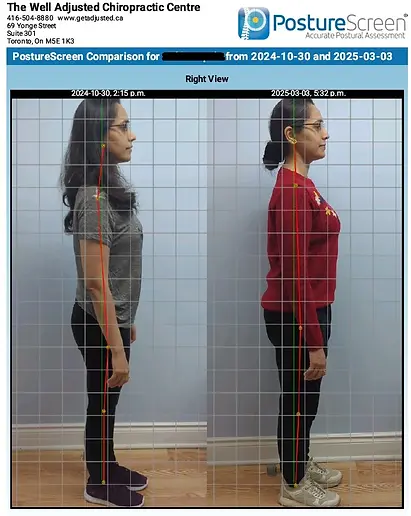
A.A. — female patient
Assessment dates: October 30, 2024 → March 3, 2025 (approximately 18 weeks) Primary complaint: Back Pain
What the measurements showed:
A.A's lateral comparison demonstrates a clear and sustained reduction in forward head posture over 18 weeks of care. On initial assessment, her head position sat noticeably anterior to her centre of gravity — visible in the deviation of the red alignment line from the green ideal. By her progress assessment, the alignment through her cervical and thoracic spine had shifted meaningfully toward the ideal, with the postural lines tracking substantially closer together.
From the anterior view, lateral shoulder and pelvic balance both improved between assessments — the overall postural alignment is visibly more centred and symmetrical on follow-up.

R.P. — female patient
Assessment dates: October 24, 2024 → December 5, 2024 → February 3, 2025 (approximately 3.5 months) Primary complaint: Posture correction, tension reduction
What the measurements showed:
R.P.'s case is documented across three PostureScreen assessments spanning 3.5 months of care — showing progressive structural improvement at each interval.
From the lateral trend analysis, forward head posture improved consistently across all three time points. The deviation between the red actual alignment line and the green ideal line reduces progressively from October through February — not a single jump but a steady, cumulative structural shift across the full course of care.
From the anterior trend analysis, lateral pelvic shift and shoulder symmetry both show measurable improvement at each assessment interval, with the third assessment demonstrating the most balanced overall alignment of the three time points.
This progressive three-point documentation illustrates what consistent commitment to a correction program produces over time.


What these results mean clinically
Postural improvement of this nature is not cosmetic. Every centimetre of forward head displacement adds functional load to the cervical spine — load that accumulates across discs, joints, muscles, and nerves every hour of every day. Reducing that displacement through structural correction reduces the mechanical stress that drives degeneration, pain, and dysfunction over time.
The patients featured above did not simply feel better. Their spines measurably changed — documented on objective assessment at the start and end of a structured correction program. That distinction is the foundation of everything we do at The Well Adjusted Chiropractic Centre.
Learn more about our approach to posture correction and spinal alignment →
Ready to see what's happening in your spine?
If you're ready to understand the structural cause of your posture, pain, or spinal health concerns — we begin every new patient with a thorough assessment including PostureScreen analysis where indicated.
No referral needed. Same-week appointments typically available.
Call or text: 416-504-8880 Book online: getadjusted.ca/online-booking 69 Yonge Street, Suite 301, Toronto, ON